The Day I Fell on the Ballet Teacher
I got unexpectedly emotional at my joint pain programme last week.
I was on this self-propelled treadmill thing, and the trainer wanted me to let go of the handles, but I couldn't. Or perhaps more accurately, I didn't feel safe enough to.
My left side is weak because of the way I've walked for most of my life and, although the PT can see I limp, she doesn’t know my history. She also doesn’t know that I use a walking stick when I'm out and about. (Or a rollator or mobility scooter depending in the circumstances.)
I felt embarrassed, vulnerable, exposed and as if I wasn’t trying hard enough. And as I was trying to explain I got tearful.
It took me completely by surprise because I'm not generally someone who cries at the gym. Swear under my breath sometimes, maybe. Crying, not so much.
But I've been thinking about it since and I'm not sure I was 61 years old and in my Funky Diva energy in that moment. I think a part of me was only 9...
I had major surgery on my hip in the summer of 1973 which meant spending three months in a plaster cast that went from my ankle, up my left leg, around my torso to my armpit.
I couldn't bend in the middle or sit up and had to be carried if I needed to be moved anywhere.
Eventually I went back to school on those “armpit” wooden crutches. I remember feeling embarrassed because I needed to catch the bus for just one stop. It cost 2 “new” pence.
Looking back now, as a mum myself, this all makes me feel quite sad. As a typical working-class Northern family, you didn't spend a great deal of time (any) examining your feelings about things.
Things happened. You dealt with them and got on with it.
After three months in plaster, I'd lost a lot of muscle strength, and it was decided that ballet lessons might help. (No recollection of any rehab or physio.) I was understandably excited about this, thinking I would to learn how to spin around on my tiptoes and wear a tutu.
So, one Saturday morning, I found myself in a cold, church hall with a varnished floor and that weird church-hall smell that always seemed to have a hint of puke about it.
The teacher asked us to stand on one leg with the other bent into a triangle, foot to knee. Passé, I now know it's called.
My balance wasn't great and I was struggling so the teacher came over to help me. She was tiny, petite little woman and as she tried to help me balance, I fell on her.
I remember feeling mortified. I was so conscious of everybody else seeing this. Conscious that I couldn't do what they could do and conscious of the fact that I'd fallen over.
That's one of my earliest memories of feeling self-conscious. There are others from around the same time.
I had a blue swimming costume with a little white skirt attached because I was conscious of the large scar running down my outer thigh.
Then there was the lemon nylon vest. It was awful, I can still picture it and feel the texture. One time, I was made to do PE in it, a horrible stretchy lemon nylon affair with white lace trim.
My boobs were just starting to develop, and I remember the absolute horror of feeling exposed.
A few years later, when I was about 12 or 13, at secondary school, boys entered the equation. "Going out" with somebody at our school didn't involve actually going anywhere.
Usually, one of their friends ran over to your group of friends at playtime and asked whether you'd go out with their mate. You said yes, then a few days later somebody informed you that you'd been dumped. Romance was clearly alive and well in the 1970s.
One of my best friends was very pretty and popular with the boys, they all wanted to go out with her. I’d had no interest from anyone I ‘fancied’. One day round at her house, her mum told me I was quite good looking and would probably get a boyfriend if I lost some weight!
I'm sure she didn't give that comment another thought. I did! And I still am 50 years later. Looking back at photographs now, I can see that I was a perfectly healthy weight. But another little piece of information had been filed away.
▪️ Maybe I'd be prettier if I were thinner.
▪️ Maybe boys would like me if I were smaller.
▪️ Maybe my body was the problem.
It's interesting laying all these memories alongside each other. I often share how clothes, hair and make-up became a huge part of how I expressed myself. Until, for a while, they weren't. My “Treble F Years” Fat, Fed up and Frumpy- were when I’d gained weight and increasingly hid myself away. I blamed my weight for all sorts of things and stopped expressing myself in the way I once had.
Eventually I found my way back to myself, yet strangely, weight loss wasn't what did it. I recently compared two photographs of myself. In one, I'm hiding in black, in the other, taken last year, I'm wearing a fabulous bright pink dress despite being heavier.
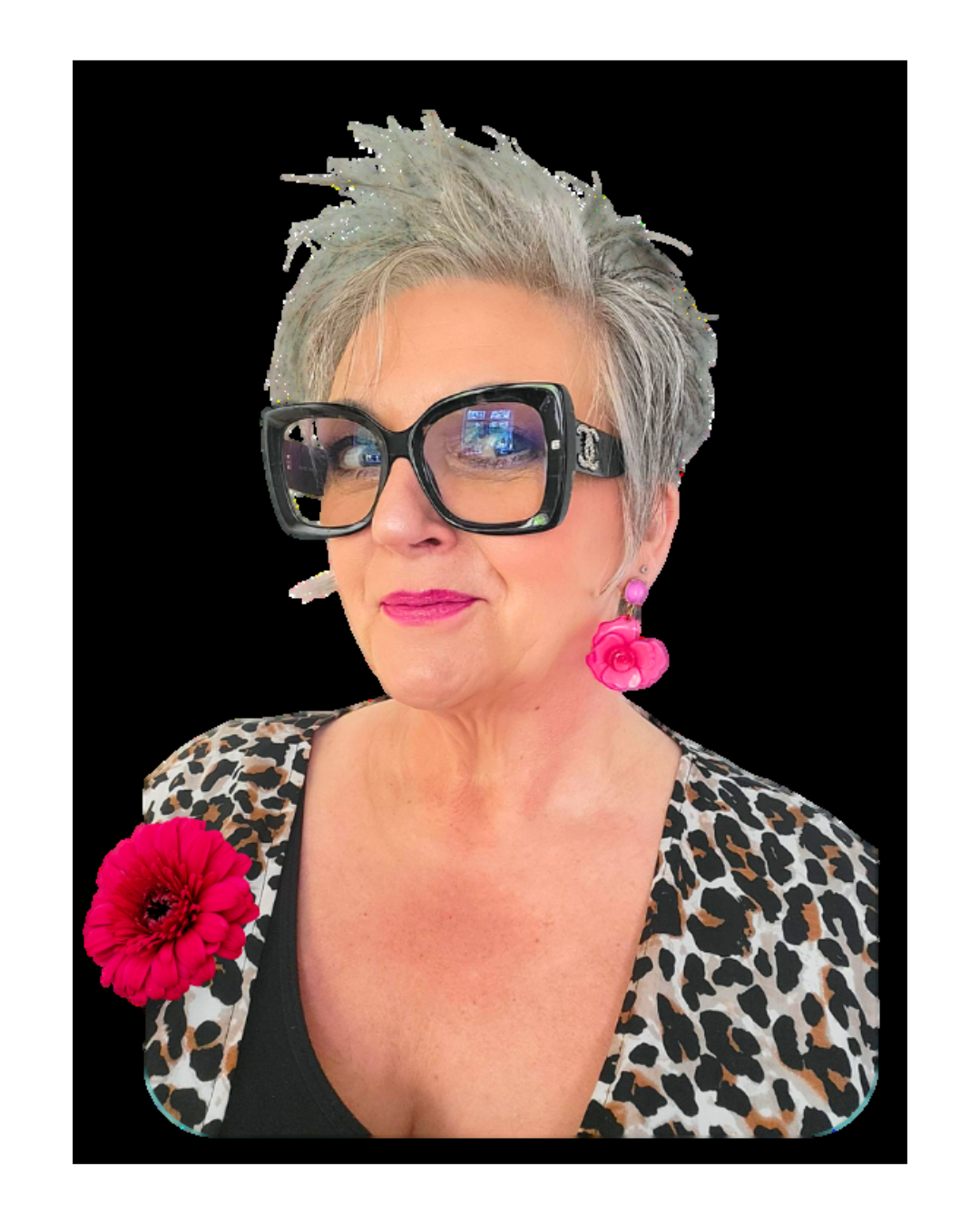
When I look at the two versions of me, the woman in pink is where recognise myself in my Funky Diva era.
Which rather buggered up the neat little story that becoming thinner was somehow going to make me more confident, expressive or more myself.
And now here I am, 61, successfully reducing my weight and trying to make my body stronger but not because I'm aiming to become acceptable in society. It’s more because I'd quite like this body to support me in doing more of the things I want to do in this phase of my life.
And I think that's why the treadmill affected me so much. For that moment, I wasn't looking at everything this body has been through. I wasn't thinking about the operations, the plaster casts, th months on tractions, the altered gait, the years of compensating or the fact that I normally use a stick.
I felt as though I should be able to do what was being asked of me and that I should try harder. Just like that little girl in the church hall trying to balance on one leg.
That’s the thing about Squishes, they don't always arrive as enormous life-changing events.
Sometimes they're tiny moments.
A comment somebody else forgets.
An embarrassing PE lesson.
Falling over on the ballet teacher.
Being different from your friends.
Feeling as though everybody is looking at you.
And somewhere along the way those moments can become little bits of evidence we collect about who we are.
I'm looking at that nine-year-old differently now, I feel sorry for her. She didn't need to try harder. She was already trying really bloody hard.
I wonder how many things we still believe about ourselves because of something that happened to a much younger version of us. And whether, every now and again, it's worth going back and looking at the evidence again.
Maybe she was just doing the best she could with whatever was happening in her world at the time. And maybe we deserve to be seen through the eyes we would use if we were our own child.